
A single link placed naturally within relevant, topic-aligned content can provide more meaningful value than multiple links placed in areas with little editorial or topical context. Links are most useful when they help readers move from one relevant piece of information to another, and contextual placements are designed around that purpose.
Understanding the practical benefits of contextual backlinks requires looking beyond raw link metrics. The relationship between the referring page, the destination, the surrounding content, and user intent can all influence how useful and relevant a link appears.
Contextual backlinks are inbound links placed directly within the main body of a web page. Unlike links repeated across site templates, these placements are surrounded by paragraph-level discussion related to the destination. This gives readers and search systems clearer context about why the reference belongs there.
Contextual Placements vs. Other Link Placements
Not all backlinks serve the same purpose. The location and surrounding content can change how a link functions for both readers and the websites involved.
| Link Type | Typical Location | Context | Primary Purpose |
|---|---|---|---|
| Contextual Backlink | Main body content | Strong topical context | Provides a relevant reference or additional information |
| Footer / Sidebar Link | Site-wide template areas | Often limited to page-level topics | Navigation, partnerships, or site-wide references |
| Author Bio Link | Author section | Attribution-focused | Identifies the author or organization |
| Resource List | Curated links page | Depends on editorial structure | Directs readers to useful external resources |
A footer or sidebar link may appear across many pages regardless of each page’s topic. A contextual placement, on the other hand, is usually connected to a specific sentence or discussion. That editorial relationship can make the reference more meaningful for readers looking for additional information.
How Context and Relevance Strengthen a Backlink
The value of a contextual placement is closely connected to the content surrounding it. The words before and after a link help establish why the destination is relevant to the discussion.
Consider the difference:
Weak context: “To learn more about financial planning, visit this resource.”
Strong context: “When structuring a commercial real estate loan, calculating the debt-service coverage ratio helps determine whether the property’s income can support its debt obligations.”
The second example provides a clear topical relationship between the subject being discussed and the type of resource that could logically be referenced.
This is one of the key benefits of contextual backlinks. When the referring article and destination page address closely related subjects, the connection is easier to understand and more useful to the reader. Contextual link relevance also helps establish a clearer relationship between connected pages.
Contextual placements can also contribute to a more naturally varied backlink profile. Different publishers may describe the same resource using their own language, related terminology, descriptive phrases, or brand mentions. This creates a broader and more organic pattern than repeatedly using identical anchor text.
More Relevant Visitors and Better User Experience
A contextual link can do more than contribute to a website’s overall backlink profile. It can also introduce genuinely interested visitors to your content.
Someone reading an article about workflow automation, for example, may be interested in clicking a relevant guide that explains a specific automation process in greater detail. Because the reference appears within a related discussion, the visitor already has some context about what they will find after clicking.
This creates the potential for more qualified referral traffic. Rather than arriving through an unrelated placement, visitors are directed from content that already aligns with their interests.
The commercial benefits of contextual backlinks can therefore extend beyond visibility alone. Relevant referral traffic may lead to stronger engagement and greater conversion potential when the destination genuinely matches what the reader expects to find.
An editorial placement can also continue providing value over time. As long as the referring article remains accessible, relevant, and visible to its audience, the contextual link may continue sending interested readers to the destination.
When Does a Contextual Backlink Actually Add Value?
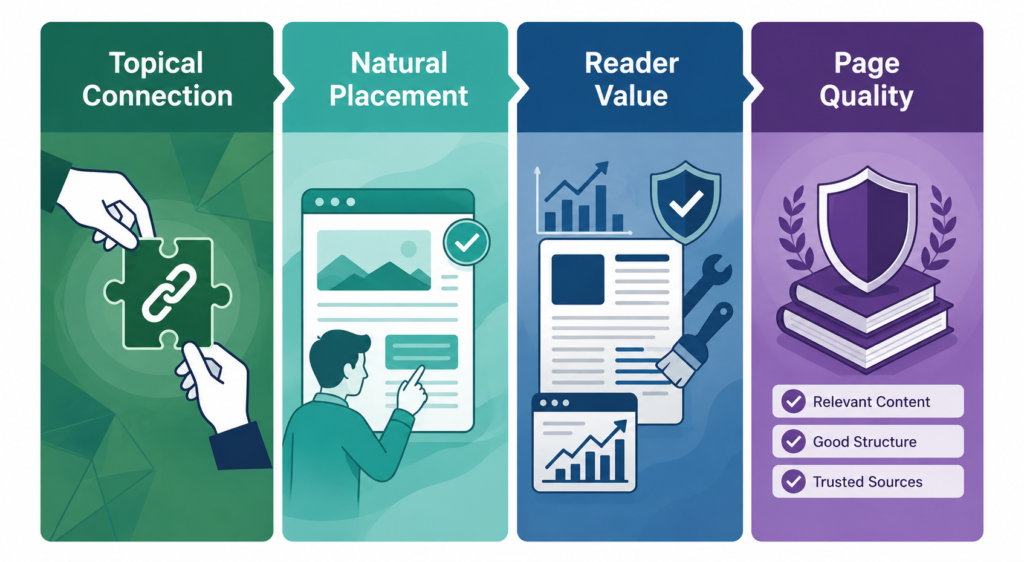
Before pursuing a backlink opportunity, evaluate the placement rather than focusing only on domain-level metrics.
Topical Connection
Does the main subject of the referring article logically relate to your destination page?
Natural Placement
Does the link fit naturally within the sentence, or does it feel inserted solely for promotional purposes?
Reader Value
Would someone reading the article benefit from clicking through for additional information?
Page Quality
Is the referring page useful, maintained, and created for a genuine audience rather than primarily existing to host outbound links?
When these elements work together, the placement is more likely to provide genuine value instead of simply adding another URL to a backlink report.
Editorial Credibility and Long-Term Value
Contextual links often work best when they are earned because a publisher has a legitimate reason to reference the content.
For example, an article may cite:
- Original research or data
- A detailed industry guide
- A practical framework
- A case study
- A specialized tool or calculator
In these situations, the link acts as a useful reference supporting the surrounding discussion. The publisher gains an additional source for readers, while the destination gains exposure from a relevant audience.
This is where the longer-term benefits of contextual backlinks become especially important. Instead of relying only on repeated outreach for generic placements, businesses can invest in content that other writers genuinely want to reference.
Creating useful, reference-worthy content does not guarantee links, but it gives publishers a legitimate reason to cite your work when it supports their topic.
Relevance Matters More Than Simply Collecting Links
A large number of backlinks does not automatically create a strong backlink profile. The relevance and usefulness of individual placements can matter just as much as the total number of links.
A smaller number of well-placed references from genuinely related content may provide more practical value than numerous links scattered across unrelated websites.
A simple question can help evaluate any opportunity:
Would this link still make sense if SEO were not part of the equation?
If the answer is yes, the placement is likely serving a real purpose for the reader.
Conclusion
Contextual backlinks are valuable because they connect related information in a way that makes sense within the content itself. Their value comes from topical relevance, useful placement, surrounding context, and effective link building that directs readers toward genuinely helpful resources.
The lasting benefits of contextual backlinks are not about placing keywords inside as many articles as possible. They come from earning references that fit naturally within relevant discussions and provide value beyond the link itself.
When relevance, editorial quality, and reader usefulness come together, contextual backlinks can become a meaningful part of a sustainable SEO and content strategy.