For over two decades, the goal of search engine optimization was simple: secure the top spot on Google. If your brand did not rank on the first page, your online visibility took a heavy hit.
The rise of generative search has changed that dynamic. Today, industry analysis on organic search and AI visibility shows that brands frequently earn AI citations in generated answers even when they do not hold the top organic spot on SERPs. Appearing at the very top of Google is no longer the sole gatekeeper to digital exposure.
To understand why this happens, it is helpful to look at how traditional search rankings and AI citations differ in how they evaluate and process web content.
Google Rankings and AI Systems Serve Different Purposes
Traditional search engines are built to organize, rank, and present a list of webpages based on broad authority, backlinks, and user interaction signals.
In contrast, generative search platforms such as ChatGPT, Perplexity, and Google AI Overviews are designed to synthesize information. They extract relevant facts from across the web, compile a comprehensive response, and attribute key statements to source links. Because these systems prioritize direct answers over webpage rank order, a site ranking fifth or tenth on Google can easily become a primary source if its content best answers the user’s specific prompt.
Relevance to the Specific Question
Google often favors large, authoritative domain names for broad keywords. However, generative search tools focus heavily on semantic matching for precise, long-tail queries.
If a user asks a complex or narrow technical question, an AI system may pass over a high-ranking broad article in favor of a specialized resource that provides a precise, direct answer.
Illustrative Example:
A major tech publication might rank first on Google for the broad term cloud security. However, if a user asks, How do you configure micro segmentation for legacy healthcare databases?, an AI search system may cite a smaller, specialized security firm that wrote a clear, dedicated guide on that exact topic even if that firm ranks on page two of traditional search results.
Clear, Specific, and Well-Structured Content
How content is formatted affects how easily machine models interpret it. AI systems process text more efficiently when information is presented clearly. Content with descriptive headings, concise definitions, structured bullet points, and explicit data points allows retrieval models to isolate key answers quickly. Building machine-readable content structures does not guarantee selection, but it removes extraction friction for algorithmic systems.
Credibility and Supporting Evidence
AI platforms aim to minimize hallucinated or inaccurate statements. As a result, systems favor content supported by:
- Transparent primary sources and statistics
- Original research or proprietary data
- Clear expert contributions and author credentials
- Well-referenced claims
High factual accuracy and robust supporting evidence make a page a safer, more reliable source to reference.
Information Available Beyond a Brand’s Website
AI retrieval models evaluate broader context across the web. If independent publications, industry trade journals, expert interviews, or research papers mention a brand’s expertise, models can draw on those third-party nodes to understand context. Off-site citations strengthen the overall credibility profile of a topic or brand.
Narrow Expertise Versus Broad Authority
A massive website with high domain authority may cover a topic generally, while a niche website focuses entirely on a specialized subject. When an AI system evaluates content depth for a specific query, specialized depth often carries more weight than general domain popularity.
AI Citations Vary Across Platforms and Queries
Source retrieval is non-deterministic and constantly evolving. Platforms like ChatGPT, Perplexity, and Google AI Overviews use distinct retrieval mechanisms, index sources, and language models. A brand receiving AI citations on one platform or for a specific phrasing may not appear for a different query or on another system.
How Brands Can Improve Their Visibility in AI Responses
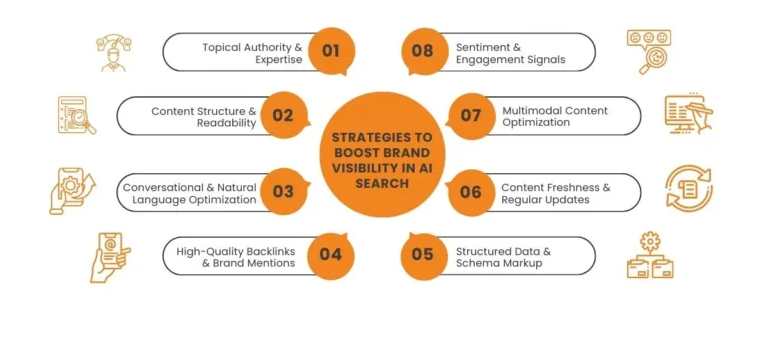
While no single tactic guarantees inclusion, brands can align their content strategy with how modern generative systems retrieve data:
- Answer Specific Questions: Focus on detailed, long-tail audience queries rather than solely chasing high-volume keywords.
- Publish Original Research: Produce unique data, case studies, and proprietary insights that others naturally quote.
- Format for Clarity: Structure content with direct answers, logical headings, and scannable summaries.
- Cite Reliable Sources: Back up claims with verified data and authoritative external links.
- Maintain Technical SEO: Ensure pages are crawlable, indexable, and technically accessible to search and retrieval bots.
- Build Natural External References: Earn coverage in industry publications and authoritative third-party sites.
Rethinking Your Search Engine Strategy
Ranking first on Google remains valuable, but it is no longer a prerequisite for gaining visibility in generative search. Earning AI citations depends less on domain dominance and more on whether your content provides the most direct, accurate, and trustworthy answer to the specific prompt being asked.