

When you type a prompt into an artificial intelligence model, the response appears within seconds. Words assemble on the screen with fluid ease, making the interaction feel almost conversational. Yet, behind this seamless user experience lies an intricate computational journey. Understanding how AI chooses answers reveals that generating a response involves much more than instantly looking up a fact or retrieving a stored text file.
Instead, an AI system translates human text into numerical mathematical representations, analyzes contextual nuances, weighs learned language patterns, and systematically predicts the best logical sequence of words to construct a reply. Here is a look inside the journey from a raw question to a final output.
Beyond Keyword Matching: Interpreting Intent and Context
Traditional web search engines historically operated by identifying specific keywords in a query and locating matching terms within a database. Artificial intelligence systems approach communication differently. Rather than looking for exact character matches, AI models process language through statistical patterns and relationships between concepts.
When a question is submitted, the system attempts to infer the overall intent behind the phrasing. It evaluates syntax, sentence structure, and the subtle relationships between words. This semantic approach allows the model to recognize that “How do I fix a leaky faucet?” and “Steps to stop a sink dripping” ask for essentially the same operational guidance, despite sharing almost no identical vocabulary.
Context plays a pivotal role in this interpretation process. The exact same phrase can yield remarkably different outputs depending on the accompanying context provided within the conversation:
- System Instructions: Pre-set guidelines or hidden developer instructions telling the system to adopt a specific tone, persona, or format (such as “explain simply” or “respond in code”).
- Conversational History: Previous messages in the session that clarify ambiguous pronouns (e.g., knowing what “it” refers to based on earlier turns).
- Supplemental Background: User-provided documents, reference material, or explicitly stated rules tailored to that specific interaction.
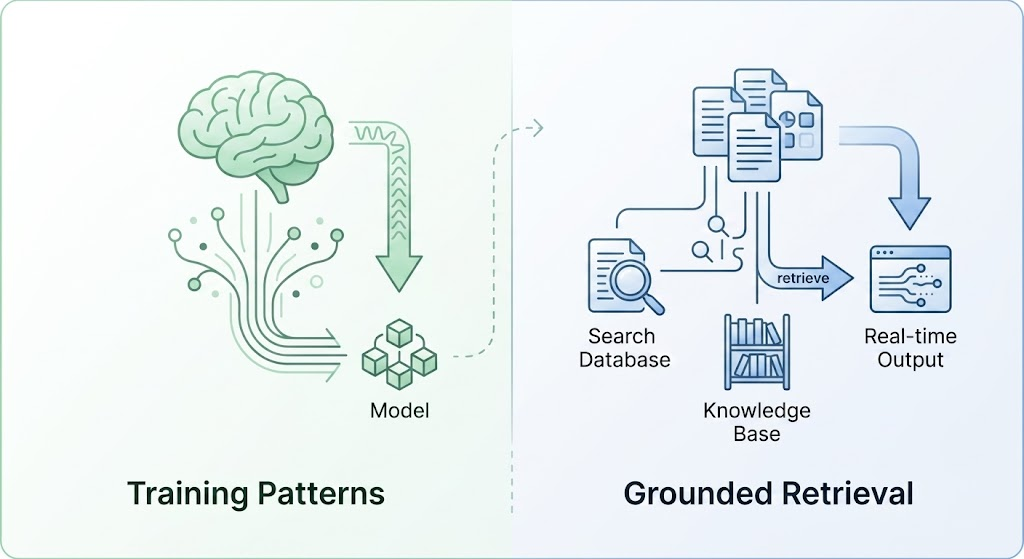
Information Sources: Training Patterns vs. Grounded Retrieval
A common misconception is that every AI model searches the internet in real-time whenever a prompt is submitted. In reality, modern architecture varies significantly depending on how the specific AI system is built and deployed.
Base language models construct responses primarily using the statistical patterns learned during their training process on massive text corpora. They do not “look up” facts in a file folder; rather, they rely on weighted connections between words and concepts embedded within their neural network.
However, many modern applications implement hybrid architectures. Some systems utilize live web browsing, external tools, or custom knowledge bases a method often referred to as Retrieval-Augmented Generation (RAG). In these setups, the system first retrieves relevant documents or live web results based on query intent, then feeds that retrieved data into the model to help synthesize an accurate, grounded answer. This process is commonly known as retrieval-augmented generation.
Knowledge Source & Architecture Comparison
| Architecture Type | Primary Knowledge Source | Key Strengths | Primary Limitations |
| Parametric (Pattern-Based) | Internal weights established during pre-training. | Fast response generation, strong creative and synthesis capabilities. | Knowledge cutoffs; potential for confident hallucination. |
| Retrieval-Augmented (RAG) | External documents, search engines, or private databases. | Access to real-time data, verifiable citations, grounded facts. | Requires reliable sources; slightly higher latency during lookup. |
Step-by-Step Generation and Relevance Filtering
When synthesizing a response, the system does not copy and paste pre-existing sentences from a database. Instead, text generation is an active, incremental process. Based on all available input the user’s question, system instructions, prior conversation, and any retrieved data the system evaluates thousands of potential word choices (or sub-word tokens) at every single step.
Relevance filtering dictates this word-by-word prediction. The AI evaluates which continuation best satisfies the context while adhering to grammatical rules and helpfulness constraints. By analyzing statistical probabilities across vast language distributions, the AI determines how AI chooses answers that maintain coherence from sentence to sentence.
Why AI Responses Can Still Be Imperfect
Despite their sophisticated linguistic fluency, AI systems do not possess genuine human understanding or factual awareness. Because their outputs are fundamentally driven by probabilistic patterns rather than conscious reasoning, errors can and do occur.
- Hallucinations: The model may generate plausible-sounding facts, dates, or citations that are factually incorrect because they match linguistic patterns without reflecting truth.
- Ambiguity Misinterpretation: If a prompt lacks detail, the system may assume an unintended interpretation.
- Outdated Information: Without active web retrieval tools, base models cannot account for events occurring after their training period.
How Users Can Guide Better Outcomes
Understanding the mechanics behind response generation empowers users to structure their prompts more effectively. The same principles of context and clarity also shape the broader world of AI-driven discovery, where systems need enough relevant information to produce useful results.
To assist the system in generating targeted responses, consider:
- Defining the Persona or Role: Explicitly state the audience or perspective (e.g., “Explain this for a high school student”).
- Providing Necessary Constraints: Set boundaries on length, format, or style (e.g., “Use bullet points and limit to three paragraphs”).
- Supplying Relevant Background: Include essential facts, source excerpts, or previous context directly within the prompt.
Conclusion
The journey from a user’s initial question to an AI’s final response involves dynamic intent parsing, contextual weighting, and real-time text synthesis rather than simple database matching. Ultimately, understanding how AI chooses answers helps users ask better questions, craft more informative prompts, and evaluate AI responses more thoughtfully.