

When planning a website’s internal architecture or analyzing backlink placement, site owners and content creators often run into a classic design dilemma: where to place blogroll links. Historically, blogrolls filled the margins of blogging platforms with lists of favorite sites, resources, and partner links. Today, choosing between a sidebar vs footer backlinks placement involves a nuanced look at design, user experience, and search engine optimization.
Rather than treating one location as a silver bullet, it helps to examine how blogroll backlinks placed in sidebar and footer areas function in practice. Neither option is universally superior; instead, each serves distinct roles depending on site design, user intent, and overall strategy.
Understanding Sidebar Links
Sidebars occupy prime structural real estate adjacent to primary content. Because they sit near or alongside core articles, sidebar links often benefit from higher initial visibility.
- Visibility and Attention: Users scanning or reading content frequently glance at the sidebar, making it a prominent spot for high-priority website navigation or secondary resources.
- Contextual Alignment: When a sidebar houses category-specific recommendations or closely related resource links, it can feel like a natural extension of the main content.
- Potential Drawbacks: Overcrowding a sidebar with excessive or unrelated links degrades user experience. If visitors perceive the sidebar as a dumping ground for random links, engagement drops, and the layout looks cluttered.
Understanding Footer Links
Footers anchor the bottom of a web page. While footer links generally receive less immediate visual attention than their sidebar counterparts, they remain an established convention for structural and informational links.
- Design and Usability: Footers cleanly house archival links, site policies, contact pages, and supplementary resources without distracting from the main reading area.
- Sitewide Exposure: Like sidebars, standard footer links usually act as sitewide backlinks, appearing across every page of the template.
- Potential Drawbacks: Because footers sit below the fold, users rarely interact with them unless they are actively seeking site information or navigation shortcuts. Placing irrelevant or low-quality links here adds little value to the human experience.
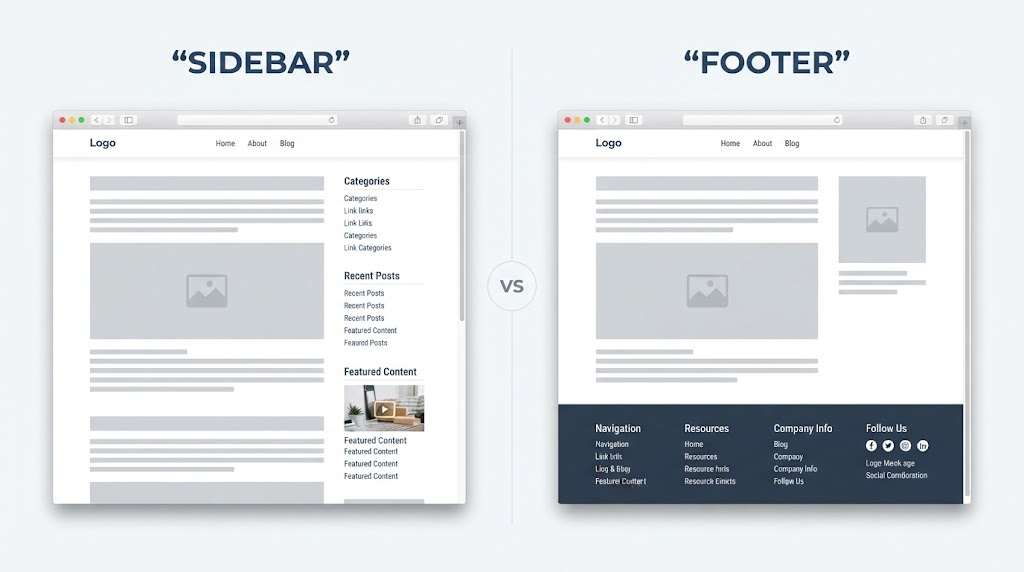
Sidebar vs. Footer Links at a Glance
| Factor | Sidebar Links | Footer Links |
| Visibility | High; placed alongside primary content and easily noticed. | Low to moderate; positioned below the fold where users look for site details. |
| Context | Can align closely with page categories or specific content themes. | Best suited for general site resources, archives, or supplementary pages. |
| User Experience | Can enhance navigation if curated; can clutter the page if overdone. | Keeps secondary links organized out of the primary reading path. |
| Sitewide Exposure | Often repeats across all pages via template design. | Typically repeats across all pages via site footer templates. |
| Referral Potential | Higher likelihood of clicks due to prominent visual placement. | Lower direct click-through rate, reserved for deliberate navigation. |
| SEO Considerations | Evaluated by search engines based on context, quality, and relevance. | Evaluated similarly to sitewide blocks; scrutinized for relevance and intent. |
Key Factors That Matter More Than Location
Debating whether sidebar links or footer links carry more inherent weight misses the bigger picture. Search engines evaluate links based on broader qualitative factors rather than simple geometric positioning.
Topical Relevance
The relationship between the linking page and the linked website is paramount. A backlink must make logical sense within its environment. If a link connects two entirely unrelated niches, neither sidebar nor footer placement will salvage its contextual value.
Natural Integration
This is especially important when evaluating high-quality contextual backlinks, where relevance and placement help determine whether a link feels naturally integrated into the surrounding content. Forced, unnatural blocks of anchor text shoehorned into a margin or footer stand out poorly to both users and automated quality assessments.
Quality and Purpose of the Website
The overall authority, cleanliness, and editorial standards of the host website heavily influence how a link is perceived. A reputable, well-maintained site offering genuine utility provides a healthier context than an unmonitored link directory.
Editorial Content vs. Sitewide Links
It is crucial to recognize how sitewide backlinks differ from links embedded naturally within editorial body content. Understanding contextual backlinks helps clarify why a link’s surrounding content and relevance can matter just as much as its location. Editorial links carry strong contextual signals because they are woven directly into the narrative. In contrast, sitewide blogroll links appear across templates, meaning search engines analyze their cumulative pattern and overall relevance with care.
Prioritizing User Experience
Ultimately, web design serves the human visitor. If a link helps users discover genuinely useful supplementary information, it supports a positive user experience. Piling high volumes of commercial or unrelated links into sidebars and footers frustrates visitors and degrades site quality.
Conclusion
Deciding between sidebar and footer link placement requires evaluating your website’s structure, audience expectations, and the specific purpose of the link. If a resource requires immediate visibility alongside core content, a clean, relevant sidebar placement may make sense. If the links are supplementary navigational aids or archival references, keeping them organized in the footer preserves a clean user interface.
Focus on topical relevance, natural design integration, and genuine utility rather than chasing a perceived positional advantage. A thoughtfully placed link that serves the user will always outperform an arbitrary placement driven purely by location.