

A brand’s identity is not established only by what the brand says about itself on its own website. While self-published content outlines your core offerings and mission, information appearing across independent sources provides vital external context about your brand, its products or services, expertise, industry, and relationships with relevant topics.
To understand how modern search engines and AI-powered systems interpret modern digital ecosystems, it helps to examine the role of external brand references.
What Are Third-Party Mentions?
Third-party mentions occur when an independent entity references your brand, products, founders, or services. Crucially, a mention does not necessarily have to contain a backlink. A brand can be referenced by name in an editorial article, publication, interview, review, industry discussion, research piece, podcast transcript, directory, or other relevant source without a clickable link.
In every case, these independent references contribute to the public digital footprint surrounding an entity.
Why Third-Party Context Matters
Search engines and AI models do not evaluate a website in a vacuum. Independent references provide crucial contextual signals about what a brand represents and where it fits within a particular subject or industry.
- Independent sources vs. self-described information: Information published solely on a brand’s own website can only reflect internal perspectives. External sources introduce an objective layer of context, corroborating claims and demonstrating how the broader market perceives the brand.
- Topical associations: When mentions appear in relevant industry content, they naturally connect a brand with specific subjects, service categories, and areas of expertise.
- Entity understanding: Consistent references to a brand name, its key personnel, and core services help algorithms build clearer conceptual associations around the business as a distinct entity.
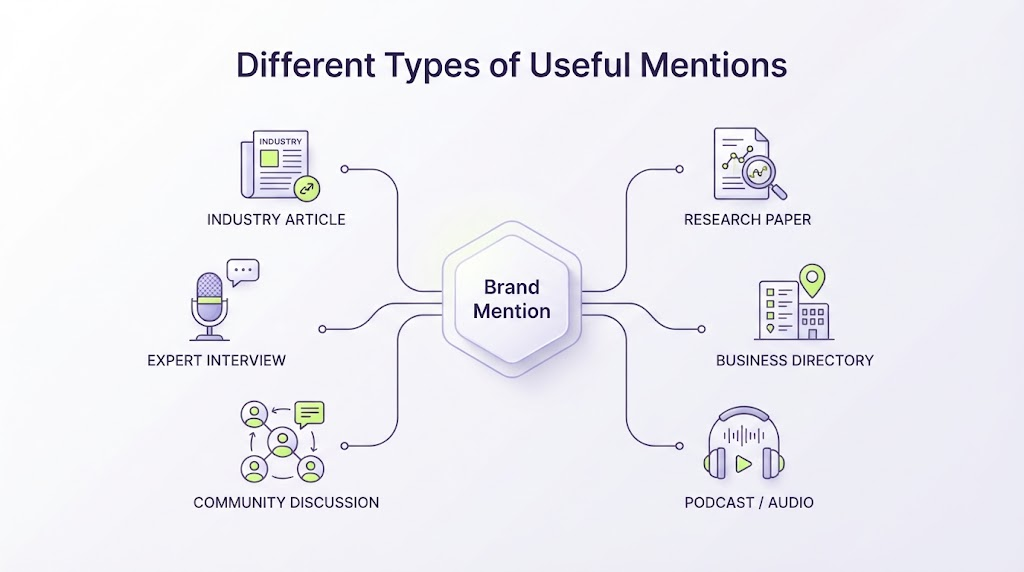
Different Types of Useful Mentions
Not all references carry equal weight. Useful third-party brand mentions typically stem from legitimate editorial sources, including:
- Industry publications and niche editorial articles
- Thought-leadership interviews and expert commentary
- Peer reviews and professional community discussions
- Research citations and whitepaper references
- Established business directories and podcast transcripts
The Role of Relevance, Consistency, and Quality
Simply accumulating a high volume of mentions is neither effective nor sustainable. Several core factors determine how meaningful external references are:
- Relevance and source quality: The context, credibility, and usefulness of the hosting source matter immensely. A mention within a respected industry publication carries far more weight than a casual, low-effort reference on an unrelated platform.
- Consistency matters: If a brand uses shifting names, conflicting service descriptions, or contradictory foundational details across the web, its identity becomes fragmented. Consistent messaging across independent platforms makes it much easier for search algorithms and third party mentions for AI models to parse accurate data.
- Mentions without backlinks: Unlinked references still provide valuable contextual information. While they do not automatically pass traditional link equity or guarantee a direct ranking boost, they enrich the broader semantic web of information that search and discovery systems analyze.
How AI Search and Answer Systems Interpret Brands
AI-powered search and answer systems rely heavily on interpreting entities, relationships, topics, and supporting evidence when synthesizing responses. When a user asks an open-ended question, these systems look across the web to understand which brands are genuinely associated with specific topics.
While third-party references contribute to the broader information available about a brand, they do not directly guarantee AI citations, direct recommendations, or specific search rankings. Instead, they form part of the cumulative context that helps an AI system accurately comprehend what a business does.
Building a Stronger Third-Party Presence Legitimately
Earning meaningful external visibility requires a focus on value and authenticity. Sustainable approaches include:
- Publishing genuinely useful research and original data that others naturally want to reference.
- Contributing expert insights to industry journalists and podcast hosts.
- Participating actively in professional communities and niche discussions.
- Earning editorial coverage through exceptional work, often starting with targeted competitor backlink research to build genuine authority in your space.
What to Avoid
Attempts to manipulate external visibility using shortcuts such as mass-generated mentions, irrelevant directories, spammy forum discussions, fabricated reviews, artificial citations, and keyword-stuffed brand descriptions often backfire. Low-quality websites built primarily to manipulate visibility offer no genuine contextual value to search engines or AI systems.
Summary
Consider two businesses: one relies entirely on self-published descriptions on its homepage, while the other consistently appears across several relevant, credible third-party sources within its niche. The latter builds a far clearer, more robust association with its industry and expertise.
Ultimately, third-party mentions contribute meaningfully to the broader online context surrounding a brand, especially when those mentions are relevant, consistent, credible, and genuinely useful.