
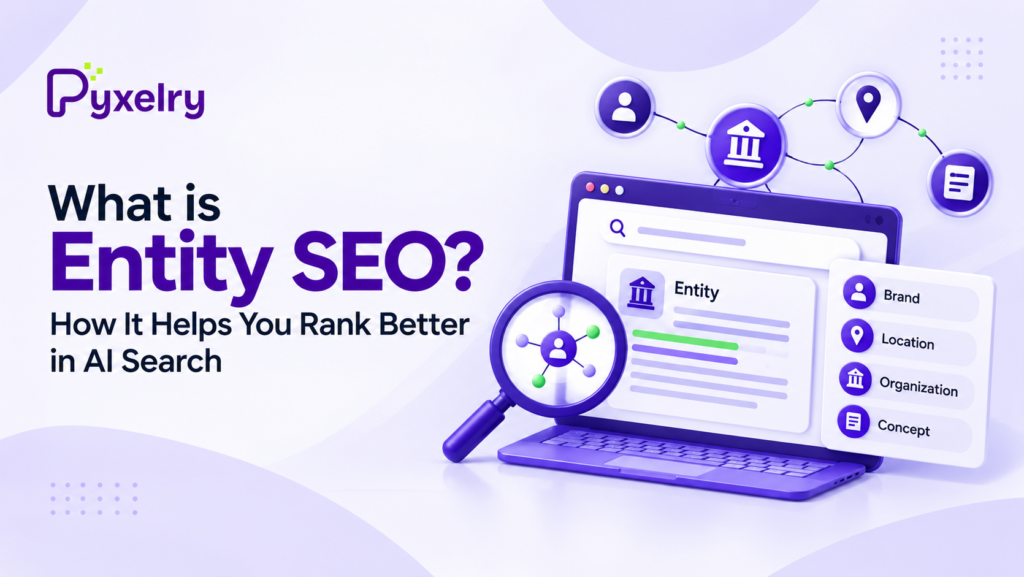
Modern search is no longer just about matching individual keywords on a webpage. When people type a query, search engines do not simply scan text for exact word matches; they increasingly try to understand the people, organizations, products, places, topics, and concepts being discussed, as well as the relationships between them. This shift marks the rise of entity SEO, an optimization approach focused on helping search engines recognize and interpret these core subjects more clearly.
What Is an Entity in SEO?
In simple terms, an entity is a distinct, well-defined thing or concept. An entity can be a person, a company, a product, a geographic location, an organization, or a specific topic. Unlike a generic keyword, which is just a string of text, an entity has a concrete identity, unique attributes, and connections to other things in the real world.
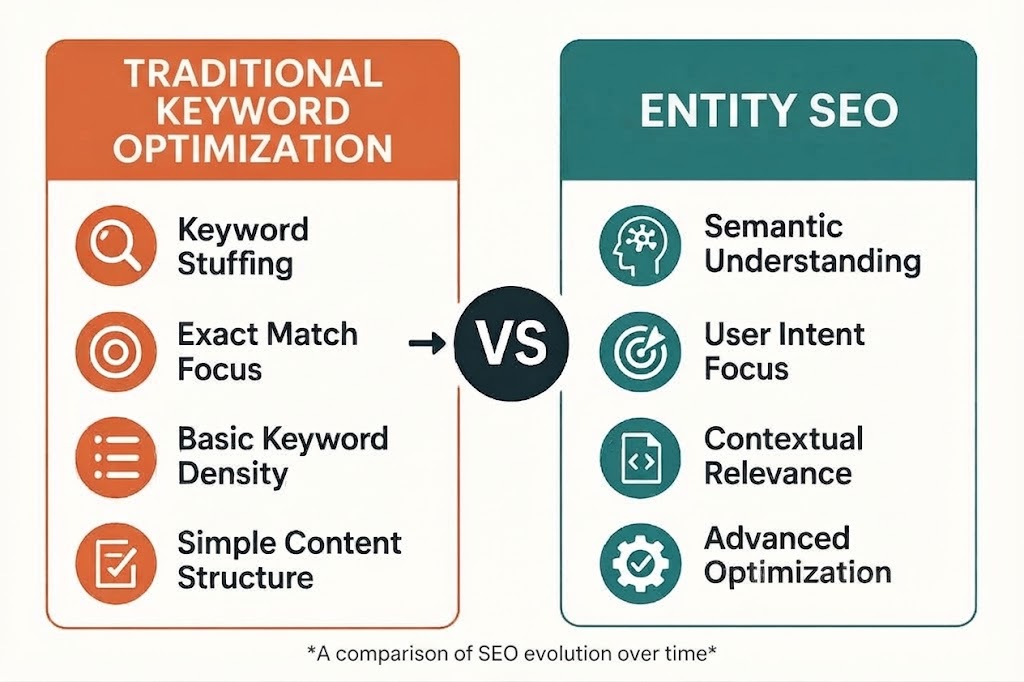
Entity SEO vs. Traditional Keyword Optimization
Traditional optimization often focused heavily on repeating specific words or phrases to signal relevance. However, simply repeating keywords is no longer enough to establish clear topical meaning. Entity SEO moves beyond surface-level words by focusing on semantics and context. It helps search engines see the broader picture of what your content represents.
How Search Engines Understand Entities
Search engines build a web of meaning by analyzing several key signals:
- Consistent information and facts across the web.
- Clear context provided by surrounding text and subtopics.
- Logical connections to other recognized entities.
- Authoritative references and structured data.
When these elements align, search systems can accurately map out what a page is about and how its subjects relate to one another.
Entity Relationships and Topical Context
Search engines need to understand how your website, brand, core topics, and related concepts connect. For example, if you write about a specific service, search systems look for related subtopics, industry terms, and contextual clues to verify your expertise. Covering related concepts naturally builds topical authority, giving search algorithms clearer context about what your platform specializes in.
Entity SEO and AI-Powered Search
As search evolves toward AI-powered answer engines and conversational interfaces, the underlying mechanics rely heavily on entity recognition. AI systems need to identify entities and their relationships when synthesizing information and organizing direct answers.
While practicing entity SEO helps machines comprehend your content far more effectively, it does not guarantee that your website will appear in AI-generated answers or secure top rankings. It simply ensures your information is clear and accessible for algorithms to interpret.
How to Strengthen Entity Signals
Improving your site’s semantic clarity involves several practical steps:
- Maintaining consistent business or brand information across online profiles.
- Creating comprehensive content that covers a topic thoroughly rather than skimming the surface.
- Using appropriate structured data to explicitly define key elements on your pages.
- Building logical internal links that connect related ideas.
- Earning credible mentions and references from trusted sources.
Avoiding Common Pitfalls
When refining your approach, it is important to avoid common missteps, such as maintaining inconsistent brand details, publishing thin or irrelevant content, relying on excessive keyword repetition, using incorrect structured data, or attempting to artificially manipulate signals.
To see how this works in practice, imagine a website dedicated to commercial kitchen maintenance. Instead of stuffing pages with repetitive phrases, the site clearly connects entities like equipment brands, repair procedures, and local service areas through detailed guides, structured data, and logical internal links connecting troubleshooting tips to specific service categories.
Ultimately, entity SEO is fundamentally about making the subjects, core meaning, and relationships within a website easier for modern search and AI systems to understand.