
Two backlinks can appear similar when compared through domain metrics or traffic estimates, yet the actual context of each placement may be completely different. One link may sit naturally inside a detailed discussion closely related to the destination, while another appears on a page where the connection feels weak or unclear.
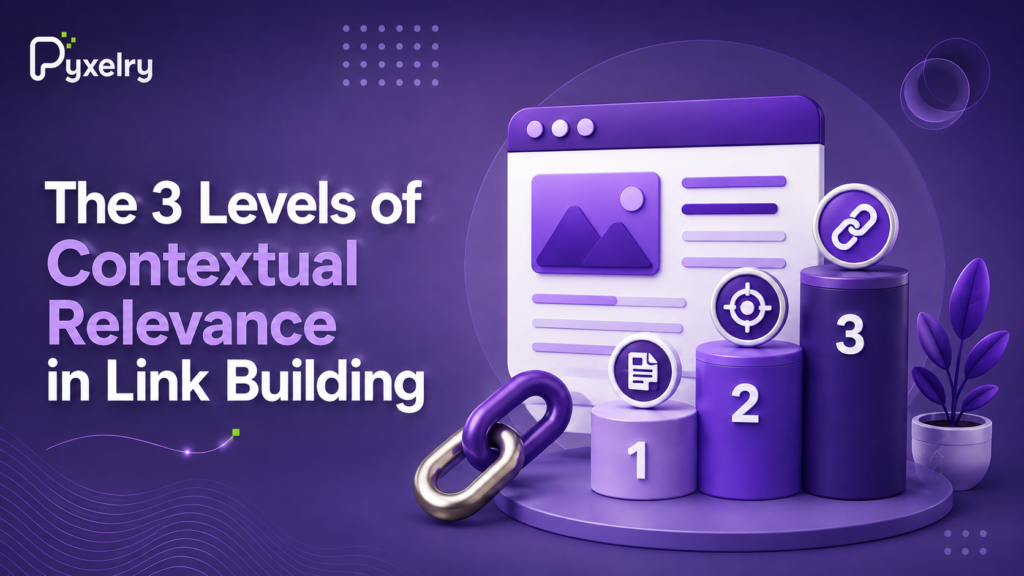
Understanding contextual relevance in link building requires looking beyond a single metric. Relevance is created through several connected layers, and a backlink becomes more meaningful when those layers support one another.
The broader website matters, but so does the specific page and the exact context in which the link appears.
Level 1: Domain-Level Relevance
At the broadest level, domain relevance looks at the general subject area of the linking website and its relationship to the destination.
For example, a digital marketing website linking to a resource about technical SEO has a clear topical connection. Both the source and destination exist within related subject areas and are likely to serve audiences with overlapping interests.
However, domain relevance alone does not make every page on that website equally suitable for a backlink. A broad business or lifestyle publication may cover dozens of unrelated subjects, meaning the individual page still needs to be evaluated separately.
A relevant domain can provide a suitable topical environment, but it is only the first layer. The actual article containing the link determines whether that broader connection continues into a meaningful discussion.
Level 2: Page-Level Relevance
The next level focuses on the specific page where the backlink will appear.
A dedicated article about email marketing strategies, for instance, provides a much clearer setting for referencing an email automation tool than a general business news article on the same website. The domain may be relevant in both cases, but the individual page determines how naturally the destination fits into the conversation.
When evaluating a placement, look beyond the website’s overall topic. Consider the article’s title, main subject, headings, and the problem it is trying to address. The destination should offer additional information that genuinely connects to that discussion.
This is where a targeted contextual backlinks service can help identify opportunities where the referring page and destination share a closer topical relationship, rather than relying only on broad website-level metrics.
Page-level relevance connects the wider topic of the domain with the specific subject being discussed. Without that connection, even a relevant website may provide a placement that feels too broad or disconnected.
Level 3: Link-Level Relevance
The final layer is the most immediate one: the exact placement of the backlink within the content.
This is where a link either feels like a natural reference or an unnecessary addition.
Several elements shape link-level relevance:
- The surrounding paragraph should establish a topic closely connected to the destination.
- The sentence containing the link should give the reader a logical reason to explore further.
- The anchor text should describe the destination naturally and set clear expectations.
- The linked page should expand on the point already being discussed.
Imagine a paragraph focused on inventory management software. Adding a reference to a guide about commercial real estate would interrupt the discussion unless there was a clear connection between the two topics.
On the other hand, linking to a resource about warehouse operations, stock forecasting, or supply chain management could naturally extend the reader’s understanding.
This immediate context is what gives the backlink its purpose within the article.
How the Three Levels Work Together
Consider a specialized accounting software company serving small craft breweries.
At the domain level, the linking website is an industry publication focused on craft beer business management. The audience and broader subject area already align.
At the page level, the article discusses managing cash flow during brewery expansion. This creates a direct connection to financial planning and accounting challenges faced by brewery owners.
At the link level, the backlink appears within a paragraph discussing equipment investment and asset management:
“Tracking depreciation on new brewhouse equipment can be easier when businesses use accounting tools designed for their specific operational needs.”
The destination expands on the same problem introduced in the article, giving readers a clear reason to explore the additional resource.
Each layer supports the next. The domain provides the broader subject environment, the page narrows the discussion, and the individual link connects the reader to a relevant source at the right moment.
Why All Three Levels Matter
Looking at only one layer can create an incomplete picture of a backlink opportunity.
Similarly, a relevant page can still contain a poorly placed link that feels disconnected from the surrounding paragraph. Understanding link relevance can help when evaluating whether a placement genuinely supports the topic being discussed.
Strong contextual relevance in link building comes from examining the complete relationship between the source and destination. The broader website should make sense, the specific article should connect to the destination topic, and the link itself should have a clear purpose within the discussion.
When these three levels align, the backlink becomes easier to understand from a reader’s perspective and fits more naturally into the content. Instead of treating contextual relevance as a single metric, evaluating each layer separately can lead to more thoughtful and relevant link-building decisions.