
The value of a backlink in SEO is not determined by domain authority alone. The anchor text and the content surrounding a link help establish what the destination is about and why the reference belongs within that discussion.
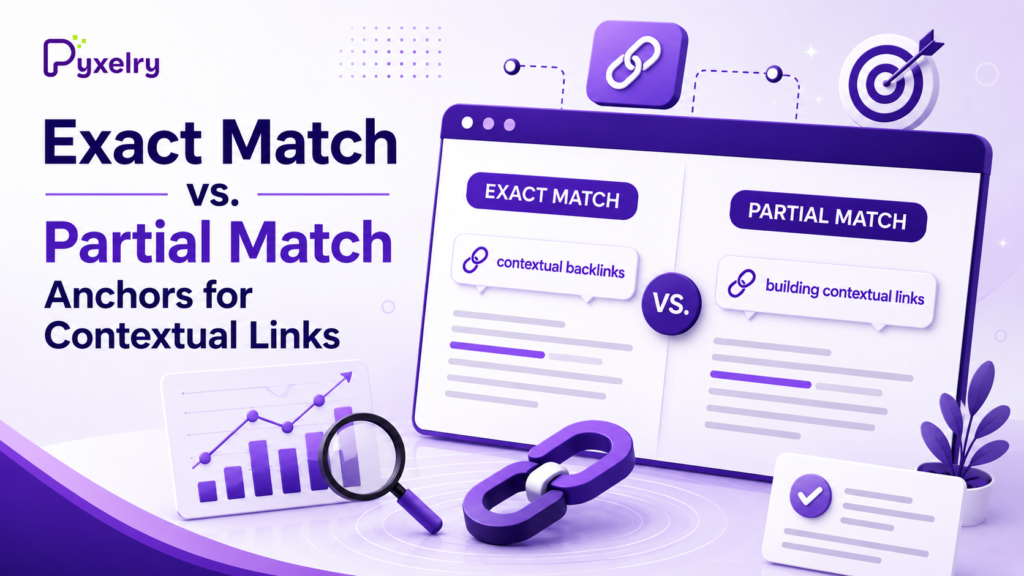
A strong contextual backlink anchor text strategy requires more than repeatedly using a target keyword. Exact match and partial match anchors can both communicate relevance, but they create very different reading experiences depending on how they are placed.
The real question is not simply which anchor type is better. It is whether the link feels like a natural continuation of the information already being discussed.
What Are Exact Match Anchors?
An exact match anchor uses the precise keyword or phrase targeted by the destination page as the clickable text.
If a page targets link building services, an exact match placement could look like this:
Many businesses invest in link building services to support long-term organic visibility.
The anchor immediately tells readers what they can expect from the destination.
That clarity can be useful. Problems begin when the same phrase starts appearing repeatedly across unrelated articles. An anchor profile should reflect the different conversations happening across the web, not repeat one keyword every time a new backlink is created.
What Are Partial Match Anchors?
A partial match anchor keeps part of the target topic while allowing additional words to shape the phrase around the sentence, which is especially useful when building contextually relevant backlinks.
For the same destination, the link could appear as:
Businesses may explore professional link building services for sustainable growth as part of a broader SEO plan.
The destination has not changed. Only the way it is introduced has changed.
That flexibility gives partial match anchors a natural advantage in editorial content, particularly when the exact keyword does not fit smoothly into the sentence.
The Same Page, Two Different Anchors
Imagine both links below point to the exact same destination page.
Exact match:
A growing company may decide to invest in link building services.
Partial match:
A growing company may look for reliable link building services that support long-term growth.
Neither version is automatically better.
The first is shorter and more direct. The second provides additional context and blends more naturally into a longer sentence.
This is why anchor selection should start with the actual article where the link will appear rather than choosing a keyword before seeing the surrounding content.
Exact Match vs. Partial Match Anchors
| Consideration | Exact Match | Partial Match |
|---|---|---|
| Connection to target keyword | Direct | Flexible |
| Sentence integration | Depends on the phrase | Usually easier to adapt |
| Level of variation | Limited | Broad |
| Context provided | Mainly through surrounding text | Often built into the anchor itself |
| Best fit | When the phrase naturally belongs | When additional wording improves the flow |
The choice becomes much easier when the anchor is evaluated as part of a complete sentence instead of as an isolated keyword.
The Context Test
Before finalizing a contextual link, try a simple test.
Read the paragraph normally and ask:
Would this sentence still give the reader a logical reason to explore the linked page?
If the answer is yes, the placement probably has a genuine contextual purpose.
If the only reason the phrase exists is to insert a specific keyword, the anchor may need to change.
This small test can be more useful than following a rigid formula for exact match or partial match usage.
Why the Words Around the Link Matter
A link does not exist independently from the article containing it. Its surrounding paragraph helps explain why the destination is relevant, particularly when building high-quality contextual links that connect naturally with the topic being discussed.
Consider an anchor related to SEO software. Inside an article discussing keyword research, technical audits, and website optimization, the connection is easy to understand.
Place that same anchor inside an article about commercial property, and the relationship becomes much less clear.
A well-planned contextual backlink anchor text strategy therefore looks beyond the clickable words. The destination topic, the referring article, and the paragraph containing the link should support one another.
Choosing an Anchor Based on the Situation
| Situation | A Natural Choice |
| The target phrase fits perfectly into the sentence | Exact match |
| The keyword feels incomplete or awkward | Partial match |
| The discussion focuses on a company or publication | Branded anchor |
| The destination is being introduced as a useful resource | Descriptive anchor |
| Similar keyword-heavy anchors already appear in recent placements | Broader contextual variation |
There is no universal anchor percentage that works for every website. A natural profile develops from variation across genuinely different editorial contexts.
Common Mistakes That Make Anchors Feel Forced
The most obvious problem is trying to make the sentence serve the keyword instead of making the anchor serve the sentence.
Repeated wording across multiple placements can also create an unnecessarily uniform pattern. So can placing a perfectly relevant keyword inside a paragraph that has nothing to do with the destination.
A good contextual link should make sense before anyone thinks about SEO.
A Simple Anchor Decision Framework
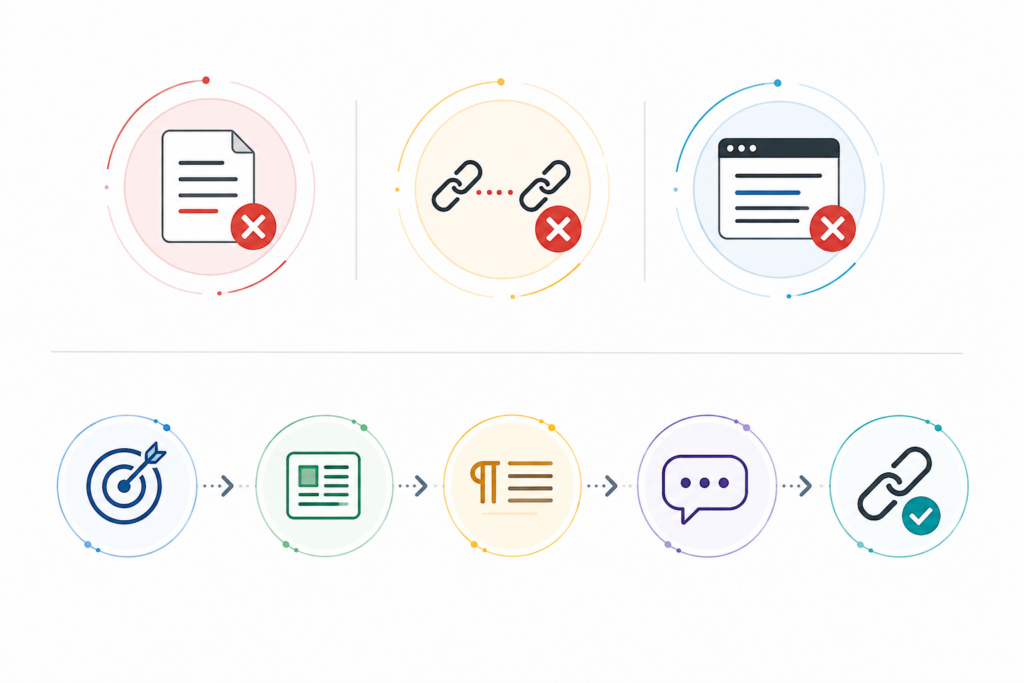
Anchor selection can be viewed as a sequence:
Destination Topic → Referring Article → Relevant Paragraph → Natural Phrase → Anchor Choice
Start with the subject of the page being linked to. Then look at the article where the link will appear.
The next step is identifying the paragraph where the destination genuinely adds something useful. Only then should the anchor itself be chosen.
Following this order prevents a common mistake: selecting an exact keyword first and then trying to force it into unrelated content.
That approach forms the foundation of a practical contextual backlink anchor text strategy because the anchor is shaped by relevance rather than inserted purely for optimization.
Final Thoughts
Exact match and partial match anchors are tools, not competing rules. One may be the natural choice in a particular article, while the other may work better for the next placement.
The strongest contextual backlink anchor text strategy focuses on the relationship between the destination, the referring topic, and the language surrounding the link. When those elements align, the anchor becomes a useful part of the content instead of looking like a keyword that was inserted for its own sake.